
Preparing to sell your business requires strategic planning, expert guidance, and a comprehensive understanding of the business lifecycle.
This guide from PKF provides invaluable insights and practical tips to help you navigate the complexities of selling your business. Whether you’re considering a sale now or planning for the future, our expertise can help you achieve the best possible outcome for you and your family.

“Welcome to our guide, designed to help you navigate the complexities of selling your business. As a Partner at PKF Smith Cooper and head of our Corporate Finance division, I’ve had the privilege of working with hundreds of business owners across most industries, on deals ranging from £1m to £250m. I have also specialised in developing best practice for selling businesses in the UK. Selling your business is one of the most significant decisions you’ll make, involving not just financial considerations, but emotional and strategic ones as well. I have developed a 9 point plan for selling your business and this is covered in this guide.
Maximising the value from a sale requires careful planning, expert advice, and a deep understanding of the market dynamics. Our team at PKF Smith Cooper is dedicated to providing you with the insights and support needed to achieve the best possible outcome. This guide is a compilation of our expertise and experience, offering practical tips and strategies to help you prepare, plan, and execute a successful business sale.
Whether you’re considering a sale in the near future or just starting to think about your long-term plans, we’re here to support you every step of the way. I hope you find this guide useful and look forward to the opportunity to work with you.
Ensuring your business is ‘sale ready’ is key to both appearing more attractive to potential purchasers, and to attracting a premium valuation. This should involve planning well-ahead by making simple improvements to operational performance prior to sale and ensuring you are legally and financially prepared.
My overriding advice to clients is to “make it easy”. This statement is wide and is meant to cover all aspects of a business such as ensuring access to information is easy, resolve issues or litigation, invest in management etc. To attract a premium, a trade purchaser must feel that there are good synergies and that business integration is going to be easy. Most trade purchasers don’t have the management bandwidth to fix issues themselves so resolve them before going to market.”
–Darren Hodson, Corporate Finance Partner
Introduction
In an ideal situation, preparing for sale should begin as early as 4-5 years before the transaction takes place. It’s crucial to have a well-structured plan that addresses all aspects of the transaction.
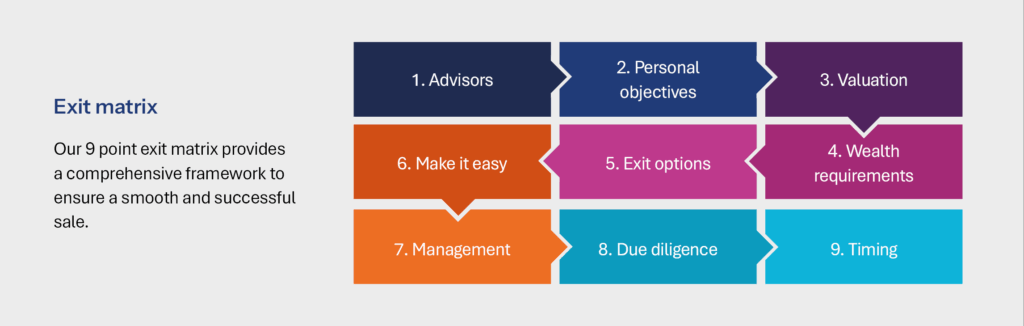
The 9 point plan
- Advisors: Develop a team including a corporate finance advisor, lawyer, M&A tax specialist, and wealth manager.
- Personal objectives: Define your goals for the sale, whether for financial security, retirement, ill health or new ventures.
- Business valuation: Obtain a professional valuation of your business to understand its market value. This will provide a solid foundation for pricing and negotiations.
- Wealth requirements: Assess your financial needs and set a minimum sale price; most vendors can sell earlier than they expect.
- Exit options: Understand different exit options like selling to a strategic buyer, private equity, a management buyout or a cash-out deal.
- Make it easy: Simplify your business by streamlining operations, dealing with all material issues, and ensuring that all processes are well-documented. A business that is easy to take over is more attractive to potential purchasers.
- Management: Ensure a strong management team is in place. Purchasers will look for a proven competent team that can maintain and grow the business post-sale.
- Due diligence: Prepare for the purchaser’s due diligence by undertaking your own. Organise all necessary documents and information. This includes financial records, legal contracts, intellectual property, and any other relevant data. Being well-prepared can expedite the process and build purchaser confidence.
- Timing: Choose the right time to sell based on market conditions, business performance, and personal readiness. Timing can significantly impact the sale price and overall success of the transaction. Typically, most vendors wish they had planned earlier than they did, and a number hang on too long.
3 observations that most vendors miss
1. Understand your value drivers
Obtain a ‘willing buyer willing seller’ business valuation so that you understand how purchasers might approach assessing an offer for your business.
This valuation will enable you to assess the key value drags and value drivers. Use this insight to improve your business and address any weaknesses – working on your business rather than in it. Having a focused improvement plan can help position your business to become more attractive to potential purchasers.
2. Improving operational performance
Most businesses are valued on a multiple of EBITDA. By understanding this, you can make simple sustainable changes to your business that can improve EBITDA and perhaps improve the multiple used. For example, a simple option is to cut out unnecessary costs.
Areas that we have seen increase the desirability and valuation of a business are:
- Delivering revenue growth
- Revenue secured by contracts/orders
- Creating an effective sales and lead generation team
- Recurring revenues from blue chip clients
- Investing in your systems and gathering key KPI information on your business
- Investing in a management team to work on the business and develop your talent
- Identifying and implementing cost improvements by making processes more efficient (including products, overheads, and procurement)
- Adopting technology to support your plans
- Reducing working capital
- Focusing on operational improvements prior to sale can lead to a greater return on the purchase price.
3. Invest in management
It may seem counterintuitive to build a management team when exiting, but it can be really important to have a strong management team at the point of exit. Many vendors think that a purchaser has bandwidth to drop in ‘spare’ management but in reality, this is highly unlikely and it may impact price and ability to sell if you don’t have a management team that can keep operating the business.
Investing in a management team also provides you with more exit options such as a management buy-out or private equity deal.
Tax implications
There are two principal areas of tax to consider when selling a business:
1. Capital gains tax (“CGT”) which is essentially the tax on any profits realised from the sale of the shares. Where the relevant qualifying conditions are satisfied, Business Asset Disposal Relief (formerly Entrepreneurs’ Relief) (“BADR”) may be available to reduce the rate of CGT levied on the first £1m of gains (per shareholder) realised from the sale transaction.
2. Inheritance tax (“IHT”) which is levied on the value of an individual’s net assets at the date of their future death. In particular, subject to satisfying the relevant qualifying conditions, business property relief (“BPR”) may be available to exempt all or part of the value attributable to shares held in a trading company.
There are areas of planning a shareholder can undertake to mitigate the impact of CGT including setting up investment vehicles or maximising the use of BADR across various family members.
BPR will become less generous from April 2026, as whilst it has historically been possible to pass shares down to the next generation on death, without incurring any IHT liabilities, this relief will effectively be capped at £1m per individual in the future. The remaining value will then be subject to IHT at an effective rate of 20%, such that many shareholders will now be considering whether to realise their value and make cash gifts to family members instead, which should fall outside of their estate for IHT purposes, subject to them surviving 7 years from the relevant payment date.
10 FAQs about selling your business
1. What happens if you leave things until “later”?
Delaying planning can result in less favourable outcomes for you, your family, or your business. Unexpected offers, changing market conditions, or personal health issues can force sudden decisions. By planning ahead, you can better navigate these surprises. We have seen people hang on too long, waiting for that ‘better’ offer, but it rarely comes. At the same time the owner’s energy to keep running the business declines, and so does the business.
2. How long does it take to sell a business?
For a full marketing process it typically takes anywhere from six months to a year.
3. How should I expect to stay in the business post sale if I am seeking to exit?
We tend to advise clients this could be up to two years post completion, but it depends on the purchaser and your role in the business.
4. When is the right time to sell a business?
Timing depends on personal circumstances, business performance, and market conditions.
5. What are the key steps in the business sale process?
The process typically involves preparing the business for sale, valuing the business, preparing an information memorandum to explain your business in detail, marketing it to potential purchasers, negotiating terms, and completing the legal and financial aspects of the sale.
6. Why do I need a corporate finance advisor when selling my business?
A corporate finance advisor will ensure you have a clear understanding of your current position and future needs, and will guide you through each step of the process – pre-sale, during the sale, and post-transaction. They help build the right advisory team tailored to your needs.
Building long-term relationships with your advisor early allows for better understanding and planning. They can support you in assessing the value of your business, which is key to enabling you to look at how to position your business for exit. They can also highlight the key risks in your business which could act as value drags.
7. What are the common mistakes to avoid when selling a business?
Many sellers don’t allow enough time to exit. If you want to retire, you really should be thinking of planning for a sale process at least 3 years before you actually want to step down. We recommend 3-4 years of planning but you really can’t start soon enough.
Common mistakes include not planning ahead, failing to get a proper valuation, not preparing the business for due diligence, not investing in management, not addressing issues early and not seeking professional advice early in the process.
8. How do I find the right buyer for my business?
Identifying the right buyer involves understanding the market, knowing what potential purchasers are looking for, and effectively marketing your business to attract the right kind of interest. Your advisor should be able to help with this.
9. I want to sell now; is it too late as I have not prepared?
The short answer to this is no, some vendors do not plan and are still able to sell. You might get a sub-optimal deal, but if it achieves the majority of your goals then it’s still worth doing. We tend to run a condensed planning session in the run up to a sale, so we can address key issues during the deal.
10. What should I do after selling my business?
Post-sale considerations include managing the transition, handling employee and customer communications, and planning for your personal financial future.
In regard to the latter, most clients don’t realise the financial pressure that comes with turning a business into cash – so, whilst you have financial freedom the pressure comes from making sure you secure it for you and future generations. This includes making sure you optimise a return on investments, but also protecting the funds from fraud. Holding discussions with a wealth advisor can be important for you to understand you options.
Here to help
To optimise value, it is important to take advice from professionals well ahead of any sale process.
Preparing a business for sale is a complex process. There is no one rule that fits all. Take time to understand your business, its value drivers and the market and, as ever, appoint reliable professionals to guide you through the process. This will ultimately ensure you achieve your aims and objectives, and also maximise the value of the deal.
Preparing for sale workshops
If you’re considering an exit or succession and want to ensure your business is well‑prepared in terms of timing, value and sale readiness, register for our specialist workshops. The sessions are delivered by our highly experienced and award-winning Corporate Finance team, who utilise deep market knowledge and transactional experience to make your next business move a success.
If you’d like to speak to a memeber of our team, please get in touch.