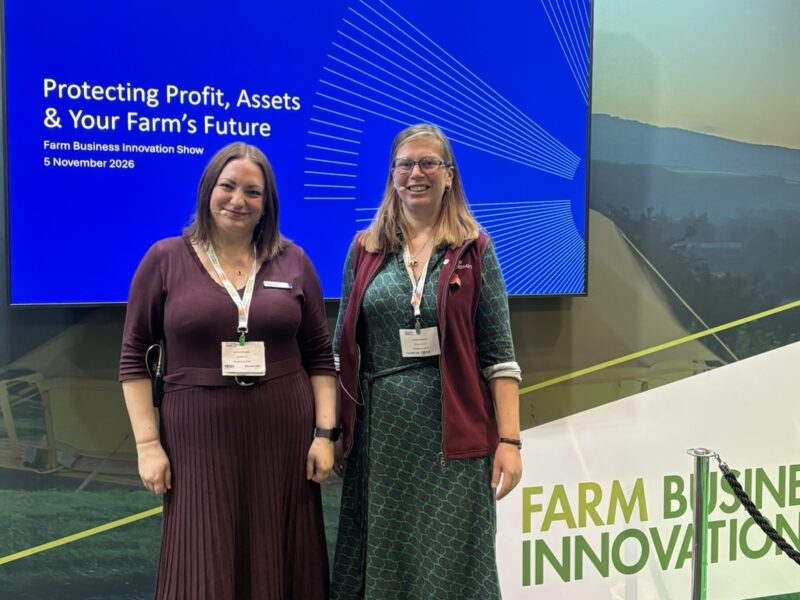
At the 2026 Farm Business Innovation Show, Natalie Pollard, Tax Director at PKF Smith Cooper, shared expertise on the implications of farm diversification, alongside Hannah Connors, Senior Associate at Browne Jacobson.

Farm diversification is rapidly growing across the UK as farmers seek to supplement traditional agricultural income. This offers farmers more financial security in the face of price volatility and fluctuating crop yields by generating profit from alternative sources of revenue.
Despite offering many potential benefits, farmers should think carefully before jumping into diversification. This is because it creates challenges regarding additional legal and policy requirements, tax, business structure and succession. In addition, it requires financial investment, meaning that funds may be diverted from elsewhere in the business, such as equipment repairs, or infrastructure maintenance.
Obtaining professional accounting and legal advice can help mitigate the risks of diversification, whilst also helping to extract the highest value from investment.
Opportunities for innovation
Diversification represents a wide umbrella of options, each with its own benefits and challenges. When considering which opportunity to invest in, Natalie recommended that farmers ensure diversification supports long-term business objectives in addition to generating income.
Technology
One avenue of innovation for farmers is in technology, which is one of the fastest-growing areas in farm diversification. This allows farmers to stay within the agriculture sector, with many opportunities available in advanced farming techniques or equipment.
Some examples include:
- Autonomous machinery, such as tractors or weeders, which can be used for enhanced harvesting
- Drones can be used to track crop health and conduct field inspections
- Robotic livestock tools can be used to automate milking and to track livestock health, fertility and feeding
These technological investments can reduce labour costs, increase crop yield and help farmers meet sustainability targets.
Another option to generate income in this arena is to become a testbed for agri-tech firms or research projects, which grant farmers access to these emerging technologies and revenue streams in exchange for hosting field trials and robotic experimentation.
Land
Land-based diversification can be a departure from traditional agricultural practices; however, it has the potential for higher-margin revenue.
Agri-tourism is an increasingly popular trend, with a 2025 government report finding that 72% of farms now partake in some form of diversification, a 10% increase over the last ten years.
The growing demand for rural holidays and local produce makes land-based farm diversification ideal to market to consumers.
Opportunities include:
- Farm shops
- Glamping
- Wellness retreats
- Nature experiences
- Seasonal events, i.e. pumpkin patches, mazes
Power
Other diversification opportunities which may present themselves relate to renewable energy. This can act as a long-term, predictable income source. In this field, returns are often linked to leases or energy contracts rather than commodity prices.
- Wind turbines
- Solar panels
- Electric Vehicle (EV) charging
- Anaerobic Digestion (AD)
In addition to revenue, power-oriented diversification can also deliver significant Environmental, Social and Governance (ESG) benefits for farms. As retailers, lenders and investors place increasing value on sustainability credentials, this could be a valuable asset.
How to protect a farm‘s profits
Strategic tax planning is vital to protect profits. This includes adapting to policy changes, such as updates to renters’ rights or inheritance tax, as well as mitigating tax liabilities.
“Tax unfortunately changes at least once a year if not twice a year… Getting regular advice is key.” Natalie emphasised the frequent evolution of tax regulations.
Cost management is another area to evaluate. Investing in farm diversification can be expensive, with potential for hidden costs, so it is important to make informed decisions and maintain efficient cost management. Being savvy about which diversification venture to select based on a farm’s assets and budget can support with this.
Another consideration is investment incentives, for example the availability of grants that could fund a diversification project, and what the eligibility criteria for these grants are.
In terms of protecting profit in the long-term, it is strongly recommended to regularly review the farming business’ structure. This is something that should evolve alongside the farm.
Questions to consider:
- Which enterprises generate the most returns?
- Do you have the funds and expertise to diversify?
- Are all assets being utilised?
- Where can costs be reduced?
- Are all reliefs being claimed?
- What is the contingency plan?
How to protect a farm’s assets
Do you have the right business structure?
As previously mentioned, having the appropriate business structure is fundamental to success, particularly when attempting to diversify or plan for the future. Having the right structure can support effective tax planning and risk mitigation.
Structures to consider include:
- Sole trade – one individual owns and runs the farm business. This is the simplest structure, and the business will be subject to traditional income tax and national insurance. Although it has minimal administrative requirements, a sole trade business can be harder to expand or pass on.
- Partnership – two or more people share ownership, responsibilities and profits. This structure is most common amongst family farming businesses. It allows flexibility in terms of profit sharing and asset ownership, with partners owning an interest in shared assets rather than the assets themselves.
- Limited company – the farm operates as a separate legal entity owned by shareholders and managed by directors. This allows benefits such as Research & Development relief, less personal liability and can help with succession or investment planning. The company pays corporation tax on its profits, whilst profits being drawn will be subject to income tax on the directors and shareholders. Whilst corporation tax rates are generally lower than income tax rates, this double layer of tax will mean it is cheaper to re-invest profits back into the farm rather than draw them out.
- Trusts – a trust can either hold the farm’s assets itself or be used in conjunction with another structure such as a partnership or limited company. There are different types of trust but generally a trust can help with asset protection as the trust property is not held by any individuals. It can be particularly useful where a successor to the business has not yet been identified as there can be multiple potential beneficiaries. Trusts work best when distributing income regularly, unlike a limited company. They can be the most complex from a tax and legal perspective, so professional advice is essential.
Succession planning
When it comes to effective succession planning, it is vital to start the conversations early. This can prevent conflict or surprises that could hinder these plans.
Clear nominees should be selected for succession, considering capability and interest. It may not be practical to divide land equally amongst family members, depending on their role in the farming business, their income and commitment to the farm.
Robust succession strategies will balance family objectives with long-term business resilience and tax efficiency.
A common concern when it comes to succession planning is inheritance tax. From 6th April 2026, the rules for Agricultural Property Relief (APR) and Business Property Relief (BPR) changed, leaving larger farming estates more liable to inheritance tax. Further details regarding these changes are discussed in our 2026 Spring Statement.
This may impact how farmers wish to organise their business structure and succession plans.
Once the decisions have been made as to when and how control will transfer, legal documentation, such as partnership agreements and wills, will need to be updated to ensure these are all in agreement.
It is also important to bear in mind that circumstances can change, and therefore succession plans should be regularly reviewed and updated to ensure they are still relevant and realistic.
Questions to consider:
- Are assets held by the right people?
- Is the structure fit for growth?
- Does the structure support succession objectives?
Common risks for farming businesses
Diversification can help to spread risk within the business, as it allows farmers to be less reliant on a single income stream. This can help maintain financial stability in the face of poor harvests, climate change and shifting agricultural policies.
One issue that can leave farmers vulnerable is not having a partnership agreement in place. This can occur in family-run farms where the agreements are not legally documented. If one partner dies, then without a partnership agreement banks can freeze the partnership bank accounts, which could leave the living partner(s) unable to cover costs.
Another risk to prepare for is out-of-date wills. Executors and trustees need to be fully briefed, so they are willing and prepared to take over the business or work with the relevant successor, as well as having aligned visions for the farm.
Land ownership uncertainty can trigger family tension and lead to people working without appropriate compensation in the interim of decisions being finalised. This should be aligned with tax relief benefits as well as family wishes.
Furthermore, farm diversification can lead to loss of eligibility reliefs due to changes in business structure or shifts in how land is used. Careful tax planning is required to mitigate or plan for this.
What are the next steps?
When considering farm diversification, it’s important to weigh up how diversifying will impact tax reliefs, as well as its alignment with long-term business objectives and succession planning.
Natalie emphasised that “the key to planning for the future is communication, both within the family and also with and between your advisors.”
Our tax team can support you with evaluating your business’ structure and optimising your tax efficiency. Get in touch for professional advice that could help you innovate your business and plan for the future.