
The UK waste sector continues to operate in a rapidly evolving environment shaped by regulatory change, sustainability targets, infrastructure investment and shifting market dynamics.

This report examines the trends that defined the first half of 2026, providing insight into transaction activity, valuation drivers and the factors influencing dealmaking across the sector.
H1 round up and outlook
Cost pressure has stepped up again
The standard rate of Landfill Tax rose to £130.75 per tonne from 1 April 2026, an RPI-linked increase from £126.15. Far more significant is the lower rate for inert and inactive waste, which increased from £4.05 to £8.65 per tonne, a 113% rise in a single year. The Government confirmed at Budget 2025 that the two-rate structure will be retained rather than moving to a single flat rate, with the gap between rates broadly maintained.
For construction, demolition and excavation-led operators moving high volumes of soils and rubble, the change is material to margin and tender pricing. The increase also places greater emphasis on waste classification and testing, as incorrectly categorised materials could result in significant additional tax exposure.
At the same time, rising disposal costs strengthen the commercial case for treatment technologies such as soil washing, remediation, aggregate recovery and other processes that can divert material away from landfill. More broadly, the continued upward trajectory of Landfill Tax reinforces a long-standing policy objective of diverting waste away from landfill and towards treatment, recovery and recycling.
This comes against a backdrop of declining landfill capacity in many parts of the UK, increasing the strategic importance of infrastructure capable of extracting value from waste streams. Operators that can help customers minimise disposal volumes are therefore likely to remain well positioned. There is also growing concern that rising disposal costs could create greater incentives for fly-tipping and illegal waste activity, increasing the importance of compliance and enforcement across the sector.
From an investment perspective, these trends continue to support demand for specialist treatment, hazardous waste, remediation, recycling and Energy-from-Waste (EfW) operators. As landfill becomes both more expensive and less available, assets that enable customers to avoid disposal costs and deliver measurable resource recovery are likely to become increasingly attractive to buyers and investors.
Carbon is entering the residual waste equation
Much of the residual waste generated is burned in EfW plants and converted into electricity instead of sending it to landfill. These plants are now being drawn into the UK Emissions Trading Scheme (ETS), the country’s carbon pricing system that requires major emitters to pay for the carbon dioxide they release.
The changes come in two stages. From January 2026, plants must begin monitoring and reporting their emissions through a voluntary Monitoring, Reporting and Verification (MRV) regime, before being fully brought into the ETS from 2028, when operators will be required to purchase and surrender carbon allowances to cover their fossil-derived emissions. Alongside this, tighter planning and environmental requirements mean new facilities are increasingly expected to demonstrate carbon capture readiness and maximise the utilisation of heat generated by their operations. As a result, carbon intensity is becoming just as important as throughput volumes and contract duration when assessing asset quality.
The impact is unlikely to be felt evenly across the sector. ETS costs will largely be driven by the fossil-carbon content of waste streams, particularly plastics, meaning facilities processing lower-carbon residual waste could enjoy a competitive advantage. Operators are also exploring how carbon costs can be passed through the waste chain to local authorities and commercial customers, creating uncertainty around future gate fees and contract structures. Carbon capture and storage (CCS) is emerging as a potentially critical differentiator, with plants able to capture emissions likely to be better positioned as carbon costs rise. At the same time, wider government policy is increasingly focused on waste reduction, recycling and circular economy initiatives, creating greater uncertainty around future residual waste volumes and increasing the importance of securing long-term feedstock.
The debate over how many incinerators the country needs has also sharpened. In August 2026, campaign group United Kingdom Without Incinerations Network (UKWIN) and 38 other organisations wrote to DEFRA calling for new incineration capacity to be halved, for the Government to confirm that incineration will enter the ETS in 2028 without exemptions, and for the publication of its Circular Economy Growth Plan. The implication is that building a new plant is becoming increasingly challenging due to planning restrictions, financing requirements, carbon compliance costs and potentially lower investor returns. That scarcity could work in favour of owners of existing, well-run, lower-carbon EfW facilities, whose assets may become increasingly strategic and valuable as capacity growth slows, regulatory expectations rise, and barriers to entry continue to increase.
Packaging EPR moves to full cost
Extended Producer Responsibility (EPR) is the system that makes the companies selling packaged goods pay for the collection and recycling of that packaging, rather than leaving the cost with councils. The scheme was phased in gradually, but 2026 is the year the full fees begin to take effect. From this year, those fees are also “eco-modulated”, meaning the amount a producer pays rises or falls depending on how recyclable its packaging is, judged against an official scoring system called the Recyclability Assessment Methodology (RAM).
Easy-to-recycle packaging attracts a lower fee and difficult-to-recycle packaging a higher one, meaning packaging design decisions now carry a direct and measurable financial consequence. Producers increasingly need support to assess their packaging, report data correctly and redesign products to reduce their future liability. As a result, businesses providing compliance, reporting, consultancy and packaging optimisation services are benefiting from a rapidly growing customer base.
The implications extend well beyond producers themselves. EPR is expected to redirect a significant proportion of packaging waste management costs from local authorities to brand owners, while also encouraging the use of materials that are easier to collect, sort and recycle. Over time, this could improve the quality of recyclate streams and support investment across the wider recycling value chain. At the same time, increasingly complex reporting requirements are elevating the importance of waste data, material traceability and compliance systems, creating opportunities for specialist software, environmental consultancy and technical advisory businesses.
For investors, the sector’s attraction lies in its combination of regulatory tailwinds, recurring revenues and growing customer demand. As producers adapt to EPR, Simpler Recycling requirements and wider circular economy reforms, businesses that help customers manage compliance, reduce costs and improve sustainability outcomes may attract significant buyer interest. The fragmented nature of the market could also create opportunities for consolidation, with larger environmental services and compliance platforms seeking to acquire specialist operators with strong technical expertise and established customer relationships.
H1 UK waste M&A
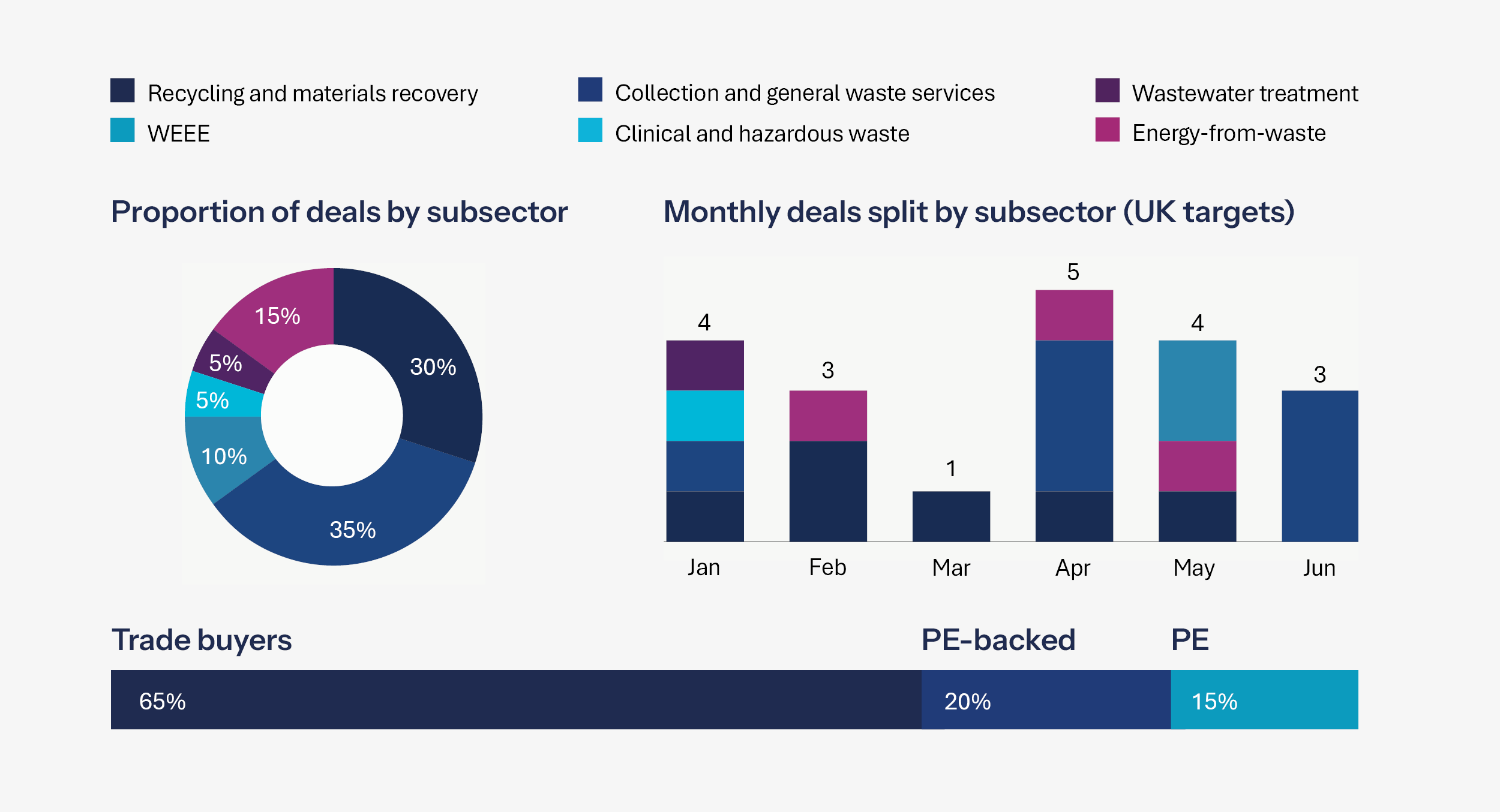
Over the first half of 2026, we saw strong deal activity in the UK waste sector, with 20 transactions and volumes on par with previous years.
Deals landed across six subsectors, ranging from clinical and hazardous waste and wastewater treatment in January, to WEEE, or waste electrical and electronic equipment, in May. Collection and general waste services was the single largest category at 35% of transactions, clustered in April and June, which points to continued consolidation of regional collection rounds where scale and route density drive margin.
Recycling and materials recovery was the most persistent theme, appearing in five of the six months and accounting for 30% of deals, consistent with the push toward higher-quality recyclate. Beyond these two, activity was thinly spread, with no other subsector exceeding 15%, which tells us buyer appetite is broad, rather than concentrated in a single hot corner of the market.
Private equity remained active during H1 2026, accounting for 35% of announced transactions, once both direct investments (15%) and acquisitions completed by existing PE-backed platforms (20%) are included. That appetite reflects the sector’s recurring revenues, its fragmented structure and the growing importance of environmental infrastructure.
The picture is not one-directional, however. Advisers and investors have cautioned that while record levels of capital are being deployed, the bar for winning it has risen sharply, with scrutiny now catching up with the opportunity. Under-invested fleets, over-gearing and legacy liabilities are increasingly the issues most likely to stall a process, and early engagement with advisers is the best way to stay ahead of them.
H1 also featured a notable exit as Endless sold Enablelink Ltd to Global Ardour Recycling Ltd. The composition of the direct PE investments is also telling. Two of the three targeted EfW and the third was a wastewater business, Bluewater Bio Ltd, rather than a traditional collection or recycling operator. Although a small sample, it suggests that financial buyers are increasingly looking to alternative and infrastructure-like corners of the waste market for their platform bets, rather than the conventional waste management firms that dominate trade activity.
AI in waste
The technology
The mainstream application is machine vision and robotic picking at Material Recovery Facility/(ies) (MRF). High speed cameras and near infrared or hyperspectral sensors classify each item by material, colour, form and contamination as it passes; a robotic arm with a suction or gripper head then extracts the target material into the correct stream.
Industry reporting puts robotic pick rates at roughly 60 to 100 items per minute against 25 to 40 for a trained human sorter, with material identification accuracy of 95-99% versus 80-90% for manual sorting. On the economics, the same reporting puts AI-assisted sorting at £5 to £15 per tonne of labour cost against £20 to £40 for manual lines.
What makes the technology so powerful is that it adapts to the specific challenge of each material stream rather than applying a single method. In plastics, near infrared sensors identify the polymer while colour and shape recognition strip out non-targets, and emerging capability is beginning to tackle long standing problems such as black plastic, food-grade identification and additive detection.
In metals, the sorting is arguably the most sophisticated, combining induction sensors that separate by conductivity, and colour recognition for non-ferrous fractions, X-ray for density and laser spectroscopy to distinguish between alloys.
A UK reference point is Recorra, which invested in a Recycleye AI-powered robotic sorting arm at its Purfleet MRF as the first phase of a £1 million upgrade, becoming the first commercial only MRF in the UK to apply the technology to waste. The arm sorts cardboard, mixed plastics and coffee cups at 35 to 60 items per minute, and critically, can be retrained as material composition and legislation change. A live dashboard tracks composition trends along the line.
Commercial impact
Labour – Sorting is one of the hardest roles in the industry to staff and retain, with high turnover and materially elevated injury rates. Automation redeploys people from picking lines to supervision, maintenance and quality control. One Northern England MRF retained 30 of 50 manual pickers as technicians and quality controllers, with wages up around 20%.
Output quality – Contamination is the single biggest determinant of whether a bale sells at a premium, at a discount or is rejected. Reducing contamination converts directly into revenue per tonne, and the gains are meaningful. Industry data from February 2026 showed AI driven systems lift recovery rates by an average of 15% while halving contamination in output bales.
A single 100,000 tonnes a year facility reported recovery rising from 85% to 95% and contamination falling from 10% to 3% after a £4 million upgrade, on a three-year payback.
Data – AI vision systems produce a continuous, item-level record of what enters and leaves a facility. From October 2026, when digital waste tracking becomes mandatory for permitted waste receiving sites, that item-level record ceases to be a desirable and becomes the compliance backbone.
Adaptability – A system that can be retrained absorbs regulatory change without recapitalising the plant.
What AI could mean for deals
AI capability will begin to affect the way businesses are priced
There are good reasons to think AI capability will begin to affect the way businesses are priced. The most immediate potential route is an earnings effect. AI-assisted sorting carries a cost of roughly a third of a manual line, a saving that would feed straight through to margin. Twinned with the potential revenue increases due to reduced contamination, there is potential for businesses to make significant gains here.
AI could reduce the risk attached to a business
A second and subtler benefit is that AI could reduce the risk attached to a business. From October 2026, waste sites must record their waste movements through the new digital tracking system rather than on paper. Buyers are therefore likely to start checking whether a target is ready for that switch, and an operator still relying on paper could raise compliance risks next to ones that already capture the data automatically.
Clean, granular composition data could become an asset
The third being over time, several years of clean, granular composition data could become an asset. It is something a rival cannot replicate at speed, and something that maps directly into EPR reporting, Scope 3 disclosure and closed loop offtake contracts.
These offtake contracts are long term agreements to supply recovered material, such as food grade recycled PET, back into the same products it came from, and they depend on the operator being able to prove the purity and provenance of what it produces. An operator whose data can evidence that quality is far better placed to win and hold these contracts, which turn on-off spot sales into secure recurring revenue. That revenue visibility is a key driver of valuation.
With sorters costing between £100,000 and £300,000 each, and full upgrades running to millions, the technology is likely to reward operators with the throughput to justify the capex and the discipline to make use of the data it produces. For sub-scale businesses, the more probable outcome is that AI becomes a reason to join a larger platform rather than invest alone, which may be one of the forces to drive consolidation of the waste sector into the future.
AI may not simply increase earnings, but also increase the valuation multiple applied to those earnings
A fourth implication is that AI may not simply increase earnings, but also increase the valuation multiple applied to those earnings. Buyers increasingly favour businesses that can demonstrate strong compliance systems, differentiated technology and resilient revenue streams. An operator with AI-enabled sorting, integrated digital waste tracking and a proven ability to produce high-purity recycled materials may be viewed less as a traditional waste processor and more as a technology-enabled resource recovery platform. If that perception translates into a lower risk profile and stronger growth outlook, the result could be both higher EBITDA and a higher earnings multiple.
AI’s impact on valuation may prove similar to what telematics delivered in logistics
Ultimately, AI’s impact on valuation may prove similar to what telematics delivered in logistics or precision agriculture delivered in farming. The first generation of adopters will use it to improve efficiency, but over time the real value may lie in the data, compliance capability and recurring revenue opportunities it enables. The winners are therefore unlikely to be those that simply install the technology, but those that successfully convert its outputs into a sustainable competitive advantage.
Next steps
Set up an initial meeting and discuss the right option for you and your business. Before the meeting it is helpful to consider the following topics:
- What are your objectives? Are you looking to exit or grow your business to the next level?
- Would you like to remain involved going forward? What is your desired timeline for exit/growth?
- What legacy do you want to create for the business and its employees?
- How has your business performed historically, and how robust are your financial systems and revenue contracts?
- What are the skill sets and ambitions of your current management team/family members working within the business?
- What are your plans for growth, and what does your business need to deliver this?